
I always have a certain anxiety when revisiting a movie that I love, especially one from when I was much younger. What if I don’t like it as much? What if it has not aged well at all? It’s only natural that as we age, our tastes and perceptions change. What we liked twenty years ago may not have the same impact as it does today. This is true with everything in our lives. I don’t have long hair anymore (thank god). I do not enjoy going out to crowded bars like I did when I was 21. And I’m confident if I still wore cargo shorts like I did in middle school, I would not be a married man today.
So I always have a little trepidation when revisiting a movie that I loved. There’s always a risk that the magic won’t be there anymore. It’s easier to not think about this with classics that stand the test of time. I do not think I will ever stop thinking about No Country For Old Men in a positive light. Sphere? One of the coolest movies I had ever seen when I was younger. Now? It is much easier to see the incoherent plot, subpar acting, and disappointing ending for what it is.
I had my wife watch Sunshine (2007, Danny Boyle) for the first time this past weekend. It is a movie that when I watched it for the first time, left me in awe. The movie’s concept, special effects, soundtrack, and plot made such a profound impact on me when I was seventeen. To me, it was one of the more unique science fiction films I had ever watched. But it’s also important to remember that I was young. I would not say that my knowledge of science fiction films was anything close to omniscient. I had not even seen 2001: A Space Odyssey, Blade Runner, or Alien at this point—so what the hell did I really know, anyways? Breaking News! Young, impressionable male is easily impressed.
I had not watched Sunshine in probably a decade. So while I still had a deep fondness for the movie, I knew there was a possibility that I could be less than enthusiastic about it this time around.
Thankfully my anxiety was unfounded.
Sunshine still rocks.

Though I recognize some weaknesses in the movie, I still deeply admire many of its original elements and have gained a newfound appreciation for a few aspects I hadn’t before.
First, let’s knock out one of the negatives: the concept of the sun dying and going on a mission to restart it with a massive bomb hasn’t been done before—probably because it’s not a super believable plot line. If that plot line alone got an eye roll from you, I would say it is deserved. Sunshine is only nine years removed from Armageddon, a film that’s plot line has been mercilessly shredded apart for an innately dumb plot line—sending drill workers to an asteroid to break it up before it hits earth. But the genre is science fiction. We are allowed to dream a little bit, aren’t we? Where Sunshine might fail in a believable plot line, it more than makes up for in being entertaining.
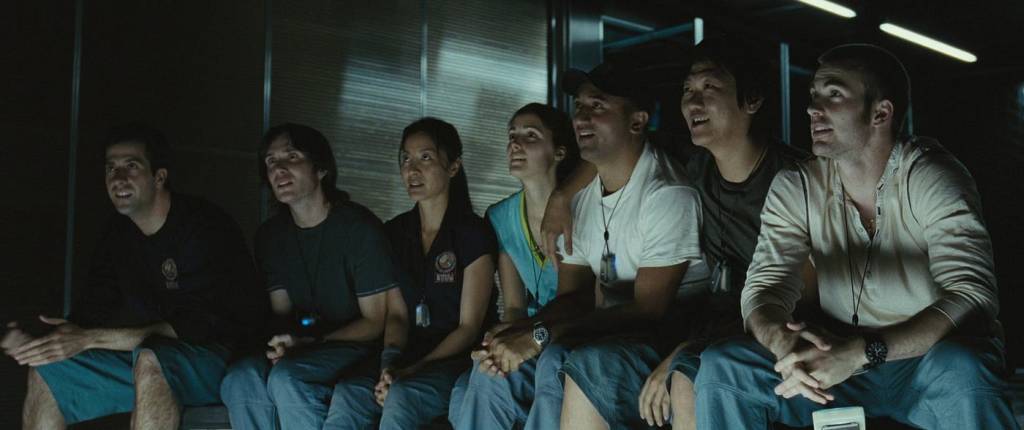
What surprised me the most this time around? Just how stacked this cast is. When I first watched Sunshine, I of course recognized Cillian Murphy, Chris Evans, and Michelle Yeoh. But their respective careers in 2007 are much different than today. Murphy and Yeoh have added Oscars to their name, and Evans went into Marvel fame. The cast also includes Rose Byrne, Hiroyuki Sanada (Emmy winner for Shogun), Cliff Curtis, Benedict Wong, and Mark Strong. Chris Evans is the highlight, as he plays an excellent asshole as engineer James Mace, a man who won’t compromise the mission for any reason—even if that means being a jerk to people’s faces. You won’t find career acting highlights from the others in the cast, but it’s passable enough to the point where it does not detract from the film. It’s just neat to look back in time and see all of these actors are earlier stages of their careers.
Sunshine is still a marvel to look at visually. Many of the design concepts in the movie still stand out eighteen years later. From the start, you notice that the ship design is incredibly different than anything you’ve seen. The ship, aptly named Icarus, is a long skinny ship with a gigantic shield in front of it to block the intensity of the sun. The Icarus is not a warship from Star Wars or a futuristic saucer like the U.S.S. Enterprise from Star Trek. The means here aren’t to deliver a ship that can maneuver through galactic battles. It’s a ship to deliver a bomb to the sun and its design reflects that. The suits used for space walking are encapsulated in solid gold to absorb the heat from the sun and reflect its radiation. The tiny visor is a stark contract from the big visored helmets from modern space missions. It also acts as a claustrophobic element in the movie. The added wide angled cinematography of obscuring their faces so you cannot even see in full view further adds the stripped identity. Here the astronauts are mere specs so tiny in nature that, compared to the size of the sun, they can’t even be measured
The “earth room” is a therapy room which can transport you to a number of locations on earth. In one of the coolest transitions in the movie, Mace stands before a sea barrier where waves come crashing down. As the waves splash and come raining down, they suddenly freeze and the room transitions into a lush forest. In a world where the sun is dying and the future looks bleak, it’s a refreshing respite in the movie. Science fiction loves to point out how technology can make human life worse, so it was nice to see an invention that seems to benefit the astronauts. Hell, if this thing existed in real life I would happily give up one of the rooms at my place forever.

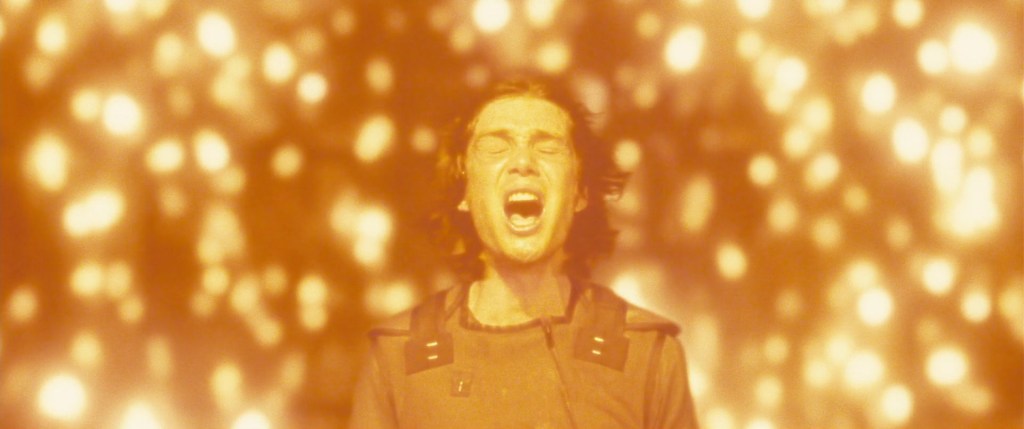
But you can’t talk about this movie without talking about the sun room. An observation deck on the ship, it’s heavily tinted at over ninety-nine percent to allow the astronauts to look directly at the sun. In the black void of space, the dying sun is still glorious to look at. Here lies the giver of life in the solar system, where life would cease to exist without it. Director Danny Boyle and cinematographer Alain H. Kuchler use extreme close-ups of the characters eyes in comparison to the magnitude of the star. It invokes a sense of transcendence in the characters that almost feels spiritual and intimate. All of the characters who find themselves obsessively in the sun room are more isolated from the rest of the crew. In combination with its God-like presence and the importance of the mission—it is easy to see why some people would be driven to madness.
The soundtrack by John Murphy and Underworld could not have been a more perfect pairing. The track Sunshine (Adagio in D Minor) is one of the best tracks used in the history of cinema. Its use in the scene where Kanada and Capa must go out to fix the heat shield of the ship elevates the scenes importance. The slow buildup of the track mimics the danger the two find themselves in as the ship corrects it’s angle and puts their lives at risk. As the intensity builds, the ever inevitable danger of the suns powerful rays come closer. It should come no surprise that its been used in countless movies such as No Time To Die, Top Gun: Maverick, X-Men: Days of Future Past, and the television show The Walking Dead, to name a few.

–Slight spoilers in this paragraph-–
If you venture online, it’s hard to encounter any sort of discussion on Sunshine without talking about it’s genre-twisting and hard turn left at the halfway point. While it has drawn the ire of countless people since its release—I was surprised at how little it bothered me all these years later. Perhaps I’ve just come to a stage of acceptance. Maybe it is classic case of me willing to overlook the movies faults because it excels at so many other aspects. But it did not hinder my enjoyment of the movie in any way. I won’t stand in the way of anyone who feels otherwise, however, it is a very valid criticism.
In a endless vacuum of science fiction media that takes place in space, Sunshine stands out on its own. I think about many scenes from this movie years later and have discussed many scenes, design elements, and more with friends and family (many of which I did not write about here). Whether you love it or not, it’s memorable. At the end of the day, that is what a lot of filmmakers in Hollywood strive to do. I always mention a quote from George Clooney about what he judges as the success of one of his movies:
“I don’t believe that films are measured by their opening weekend. I think they’re measured by the test of time.”
Eighteen years later, Sunshine is passing that test.



 hunter albert
Leave a comment