Guest write-up by Max Tackett
I’m always fascinated to see the films and TV shows people return to frequently. We revisit our pop culture haunts because they resonate with us in a specific and personal way. Why do I feel the need to destroy myself by rewatching Sound of Metal and Soul every time fall rolls around? Some would say I’m a masochist. Why do I find myself cracking open a cheap beer each time I’m reintroduced to Rick Dalton and Cliff Booth in Once Upon a Time…in Hollywood? I’d argue it’s mandated by law. But why do these films, and others such as Uncut Gems and Annihilation all fall into my personal pantheon? I think I see a bit of myself in all of them.
Audiences feeling represented in film has been a hot-button topic in the last 10-ish years, wherein directors are compelled to reflect the viewer’s race, sexuality, and gender back at them as a form of allyship and affirmation. What about movies that allow us to fantasize about versions of ourselves that don’t exist? Or how about films that challenge that view of self, reflecting our own ugly shortcomings in a way that can’t be ignored (sounds like a blast, I know!)? I’ve found this to be true with all of my most heavily rewatched favorites, but I have a special appreciation for one in particular: Blade Runner 2049.
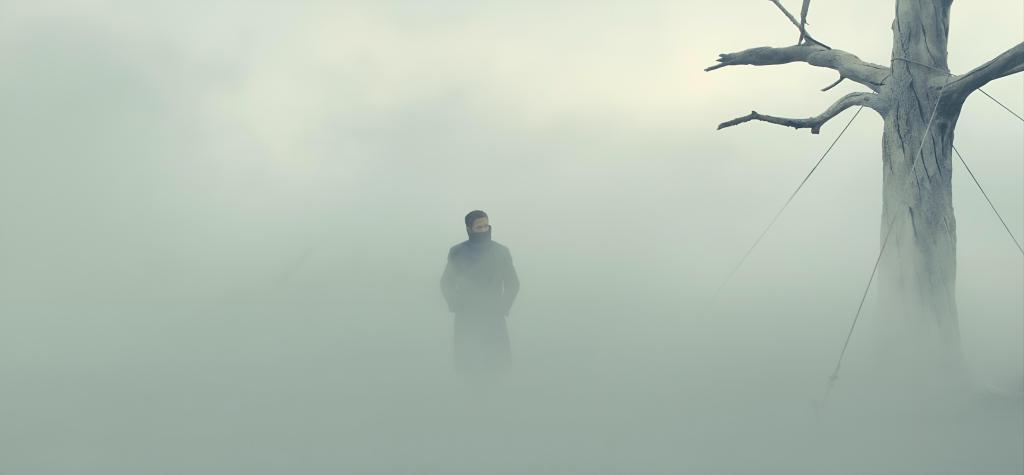
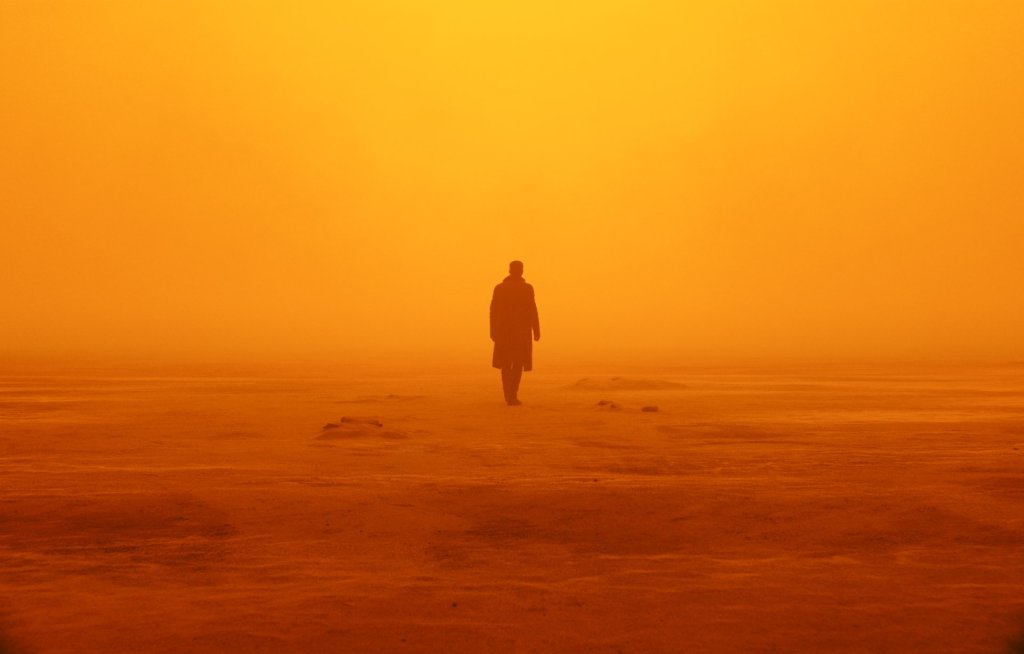
2049‘s immediate appeal is undeniable: it is a visual feast. This is certainly true for the original Blade Runner as well, but 2049 takes it a step further by blending worlds that could each warrant their own 2.5-hour-long epic. Los Angeles is a grimy, rainy, and dark hellhole – a maze of gigantic neon projections of advertisements and sex dolls. Early on, we see the Wallace and LAPD corporate offices looming largely over the skyline, introducing us to the two villainous presences of this post-apocalyptic California. This is mostly in step with the original film, but director Denis Villeneuve widens the scope by including extended sequences in the daytime as well. K’s opening visit to Sapper’s farm drops us directly into a foggy expanse covered with millions of solar panels that are likely fighting for their lives, and San Diego is a much brighter but more decrepit version of LA, as it houses all of the latter’s trash (there’s a funny joke in there). K’s visit to Las Vegas is certainly the stunner of the film, though, and it’s jammed full of striking images that have stuck with me in the seven years since the film’s release. An orange haze of filth hangs over the entire city (foreshadowing a real and horrifying weather event in San Francisco in 2020) as K slowly stalks through a barbaric hall of monstrous sculptures of naked women, monoliths to Vegas hedonism. Deckard, Blade Runner’s original hero, has made his makeshift home here in a dilapidated but ornate casino loaded with booby traps. K’s first introduction to him comes through the silhouette of an old dog, a haunting figure that could pass as a wolf at first glance. Deckard and K’s fistfight, which never fails to put a smile on my face, takes place in a concert hall where a glitching projected performance of Elvis and his Vegas showgirls cuts in and out as the two repeatedly punch each other in the face. Each of these sequences alone would be standouts in most films, so it’s safe to say that 2049’s staying power is strongly related to its abundance of moments like these.
Everything I just detailed isn’t news to anyone who’s seen the film, though. In fact, many detractors have suggested 2049’s visuals are its only strong point. I’ve seen critics (haters) describe the film as “boring” and “slow,” and the film’s box office bombing has made it a bit of a forgotten cult classic less than ten years since its release (the nearly three-hour runtime probably didn’t help). While I understand the gripes, I find 2049 to be a beautiful and heartbreaking reflection on how we all long to know where we fit in the world.
Officer K is as dependable of a Blade Runner as they come. He follows orders, he gets the job done, and he doesn’t talk back (a superior at the police station even refers to him as “Constant K”). We see him go home each day to a dreary apartment that’s brightened by Joi, an AI hologram produced by Wallace Corp that simulates a real romantic companion he can talk and interact with (kind of). Early in the film, we see K longing for an intimate connection with Joi as they lean in to embrace in the falling rain. Just as the two are about to kiss, Joi freezes as an incoming call from K’s police chief comes in. We see the pain in K’s eyes – he longs for much more than simply hunting replicants at his 9-5.
K comes to learn that years ago, a fellow replicant miraculously reproduced and gave birth to a set of twins. After considering a series of memories that may or may not have been implanted in his “brain,” K starts to believe that he may be one of the twins (Joi even starts referring to him as “Joe,” claiming he’s “a real boy,” which he is initially resistant to). He follows this hunch and is driven to pursue the truth, hunting to confirm he is a part of this miracle. This pursuit comes with a price, though. Both Wallace Corp and the LAPD take interest in this mystery, the former wanting to monetize it and the latter wanting to stamp out word of it reaching the world at large. K’s work and overall wellbeing are thrust into turmoil as his superiors hound him to get rid of this problem and Wallace’s agents stalk him closely.
(SPOILERS AHEAD)
2049 continues to ratchet up the stakes and tension throughout K’s journey until culminating with a seemingly anti-climatic reveal: K’s memories of his childhood are, like every other replicant, merely copies implanted into his programming. It’s revealed to him that he is not, in fact, one of the twins, and Deckard, who we come to learn is the father of these replicants, has no ties to K. His dreams and hopes for his novelty are merely a fantasy that many of his kind have felt. There is nothing spectacular to his existence, and his idealized purpose is lost in a sea of others just like him.

How inspiring! Ridley Scott’s Blade Runner wrestled with the idea of Deckard’s humanity, but 2049 completely takes the wind out of its own sails by removing any doubt with K. If he’s just a robot, why does any of this even matter? I’d argue Villeneuve’s decision to confirm K is a replicant actually mirrors one of the most human experiences we can have.
The idea of being exceptional is something most American millennials were presented with at one point or another in their childhood, and most of us are now 30+ and still grappling with that notion today. “Why haven’t I moved up in my career as much as my contemporaries?,” “why can’t I find the right person to settle down with?” and “what lasting legacy will I leave?” are some of our many lingering questions. Essentially, “who am I, and where do I belong?” to borrow a phrase my father describes as the two main questions at the heart of the human condition. I have spent a good deal of my life trying to be “exceptional,” whether that be in the eyes of my loved ones, my job, or institutions I’ve been affiliated with. It’s an exhausting endeavor that truly has no end, and the goal post is continuously moving. “Getting too comfortable” with your life was often framed as a roadblock to true success and growth: satisfaction was aligned with stagnation.
When K learns of his normalcy, he sinks to his knees as he realizes he’s just another replicant. He has experienced a great loss and is left to decide how he’ll proceed from this moment. On the surface, K responds as any Hollywood leading man would and gets the hero’s redemption: he begins donning the name Joe as he embraces his new identity, and he saves Deckard from the evil Wallace Corp. It’s nothing new in terms of action flick conclusions, but the quiet resolution that follows is what struck me on my most recent rewatch.
Joe and Deckard walk together towards the snow-covered facility where Deckard’s daughter, who he has never met, resides. He turns to Joe and asks, “Who am I to you?” Joe looks back and gives a small, sad grin, pausing a moment to consider that question before saying, “Go meet your daughter.” It’s a beautifully crushing moment, as Joe painfully accepts Deckard is just a man to him, not the father he had hoped for. Joe’s ushering of Deckard to this exciting new revelation leaves our sad replicant outside on a set of snowy steps. He’s badly wounded from his rescue mission and takes note of his bloodied torso as he sits down. Joe silently watches as the snow falls into his hand, and then he slowly reclines into his final resting place, staring at the sky as he gently passes away.
Joe dies as an unextraordinary replicant, not a miracle. But I’d argue he understands himself more in that moment than ever before. He’s also chosen to prioritize someone he cares about, sacrificing his own life so Deckard can find what he’s been missing. Most of us also go on to lead lives that wouldn’t be too memorable on paper. But transcendence isn’t found in the extraordinary. It resides in the acceptance of what is and what isn’t, whether that be in life, people, or ourselves. We can’t truly enjoy the goodness that life brings if we’re constantly trying to will it into something it’s not, and once we’re able to accept that, true peace will follow. And that’s not to say this process is devoid of pain: Joe dies alone and orphaned. But he’s decided helping Deckard is a cause worth dying for. We too find a new appreciation for life and ourselves when we act selflessly and lovingly towards others.
Previous rewatches of 2049 kept me spellbound, swept away by the stunning vistas and gorgeous cinematography of its mesmerizing world. But I found more common ground with Joe on my last watch as I too work through accepting what is and what isn’t. The idea of your hopes and dreams not being fully realized isn’t as sad to me as it used to be. We aren’t the idealized version of ourselves, we’re just normal and flawed like everyone else. And that’s OK. I like that version of myself more, anyways.






 hunter albert
Leave a reply to ralbert45813acfea Cancel reply